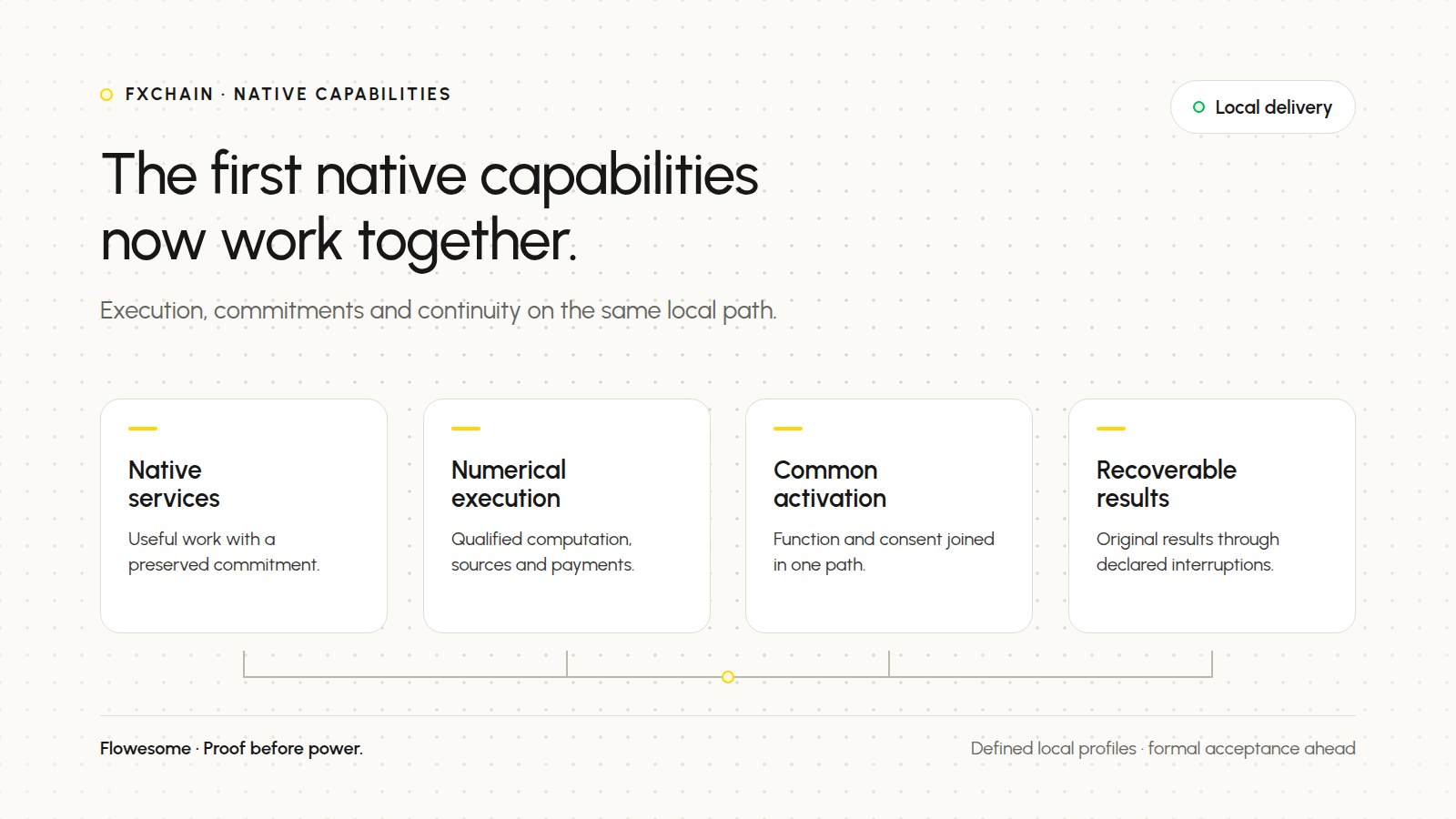
FxChain has completed a substantial local development increment under the V1.1 direction of its Architecture & Protocol Programme. Native service workflows, a qualified numerical FxVM application and their common activation now run through concrete execution paths. They preserve commitments, payments and source relationships, and their records can be reconstructed against the rules of the profiles tested.
This is an advance in what the architecture does. It also makes its direction easier to explain: useful execution, the resources that support it and the obligations it leaves behind are being brought into the same native system.
The delivery is local, documented and reconstructible. Human observation, the designated owner's formal acceptance acts and publication of this source remain separate steps. No public network or service starts with this announcement.
From a direction to useful behaviour
FxChain remains a blockchain programme with the principle Proof before power. Its native direction includes execution, resources, markets, possession, computation, confidentiality and composition between domains. The assurance, change-governance and operational programmes support that architecture; they do not replace the native work.
The latest increment connects three useful behaviours. A native service workflow provides a declared set of services and preserves its compensation and result. A numerical application produces dossiers with the source relationships and payment stages that belong to them. A common activation brings the relevant function and consent together, then performs the shared work under one coherent accounting path.
These are defined profiles, rather than a promise that arbitrary applications already run. Their significance is the connection: the result, its authority, the resources consumed and the obligations retained can be examined together.
Native services, with continuity
The service workflow produced twelve services with one compensation. Ten current cases were reconstructed, covering the nominal path and declared neighbours involving a lost activation response, a lost service response, process interruption, storage ambiguity, time and authenticated lookup.
The compensation is a synthetic credit transfer in this local profile. It is distinct from the service quota. Completing a service, reserving capacity and moving financial credit are recorded as different facts.
The delivery also retains the earlier qualified M1 continuity work. In that work, an actual process interruption after a committed result but before the client received it was followed by recovery of the original result. The effect was not performed a second time. An export was also genuinely blocked while an admissible native operation continued. Those earlier histories keep their own source and scope; the new delivery does not claim that every one was rerun on the new source.
A numerical application, with sources and staged payments
The qualified numerical FxVM application produced eighteen dossier outputs. Seven current cases were reconstructed, including lost responses, time-related continuation, authenticated lookup and pressure from a held reader. The application keeps the source relationships attached to its outputs and the staged payments attached to the work they cover.
A separate native boundary test also exercised a qualified resolution when services were not earned. It released the unearned reservations, preserved the payment already earned and returned the unused component funding lineage without inventing an additional native credit transfer. This is a demonstrated resolution path in synthetic local accounting, not a claim about a banking refund or every possible repayment path.
The underlying distinction matters: a compensation payment, release of a reservation and restitution of unused funding are not the same operation.
The first common activation
The common profile connects the qualified function with the consent required to use it. With both present, one lawful activation produces twelve paired dossier and service outputs while keeping consent, payments and source accounting coherent.
Seven declared cases completed that useful work. Three other cases deliberately withheld the function, the consent, or both. Their records were reconstructed as conditional absence outcomes, with no completed activation. All ten cases passed their applicable reconstruction checks; that does not turn the three absence controls into three successful activations.
The individual receipts do not stand in for this common result. The common histories have their own evidence, qualification and limits.
What the review established
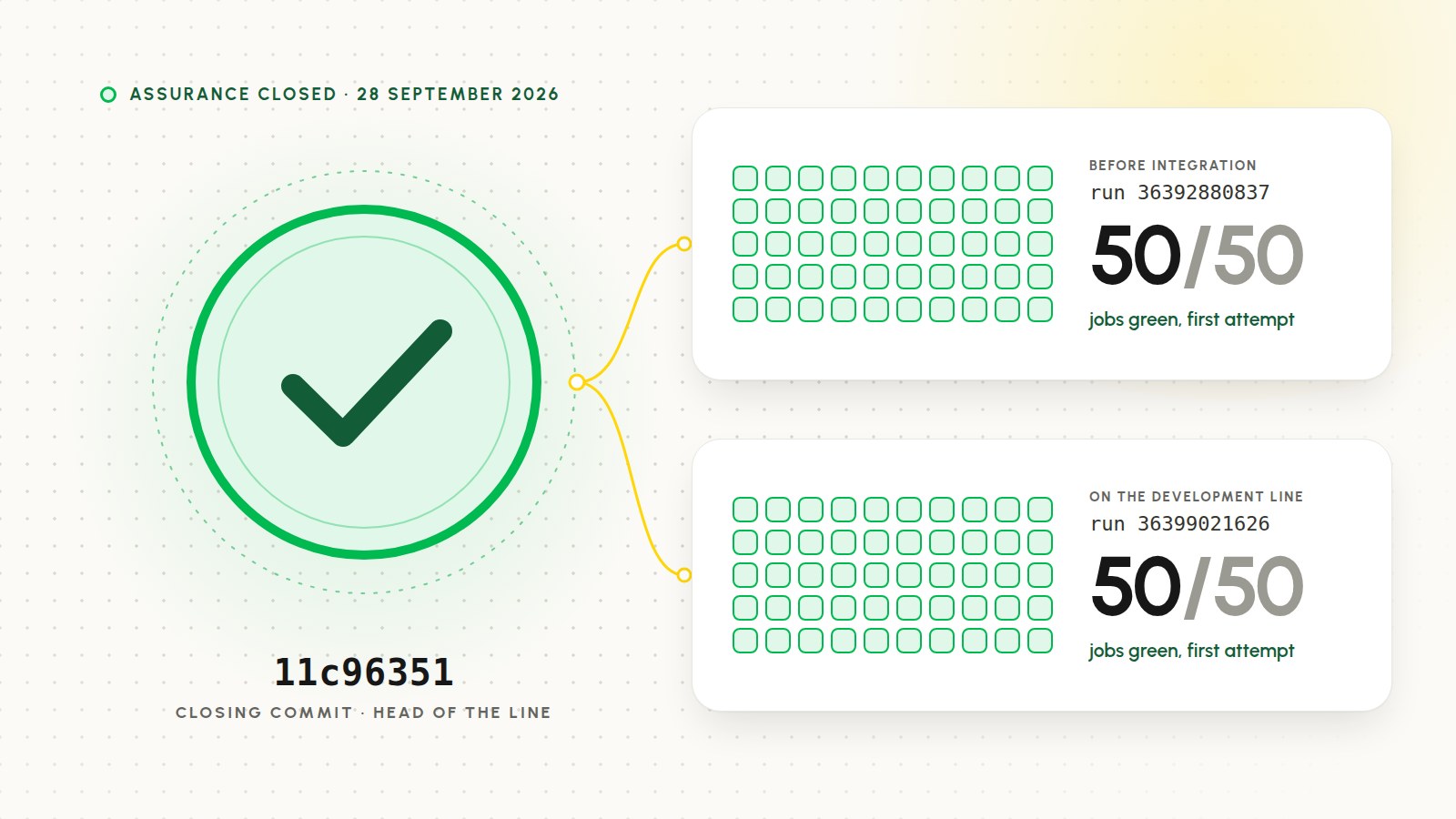
The delivery identifies the retained source and executables, the rules of the profiles, the histories produced and the reconstruction results. Local mandatory validation completed on that source, and the operational closure retained the material needed for a usable handoff.
The independent reconstruction implementation was written separately from the producer. Its review still shares a host, a model family, a toolchain and a standard cryptographic helper, and previous exposure to some histories is declared. This is meaningful separation of implementation and judgement within a local programme. It is not an external independent audit.
During review of the common profile, a bounded correction was made to the receiver's collection of external observations. The final reconstruction used the exact same execution records and unchanged product source and executable for that correction. Earlier input rejections remain recorded. This describes that specific review step, not the whole development history: product corrections made earlier in the work remain documented as changes of their own.
Competent conventional implementations were compared with seventeen standalone workflow cases under the same finite rules. That comparison does not cover the common activation and does not establish an advantage in performance, human effort or the physical fault behaviour of storage. The delivery makes no superiority claim.
What comes next
The next steps concern different kinds of evidence and must remain distinct.
- Human observation. Observe the actual source-bound behaviour and report what a person can establish, including measurements that remain unavailable.
- Formal acceptance. Have the designated owner perform the distinct acceptance acts against the exact applicable packages. Engineering results do not make that decision on their behalf.
- Controlled source publication. Verify the applicable account-wide continuous-integration capacity and publication authority before starting a remote operation. This delivery triggered no remote jobs.
- The next eligible native increment. Continue from the retained source within its dependencies and authority. Future resource-allocation experiments remain separate work, not a newly invented condition for the delivery just completed.
The broader architecture programme still includes consensus, networking, private deployment, confidentiality, possession and composition between domains. Each retains its own dependencies and acceptance boundary. A general virtual machine, a public testnet, a mainnet and a token are not accomplishments of this increment.
For a durable account of the behaviours, their place in the architecture and the gates ahead, read Native capabilities. For the existing reconstruction reading path, start with FxChain Foundations. The portal's full status remains on What exists today.